



INQUA 2605 sy: Integrating tools for investigating paleoecosystems through multiproxy analysis of coprolites (PalCoproSA)
The PalCoproSA 2605 S-Y workshop is aimed at Early Career Researchers (ECRs) and provides training in the methodologies of multiproxy analysis of coprolites and sediments.
Abstract
South America (SA) has undergone extreme shifts in faunal composition during the pulsed Great American Biotic Interchange from the Plio-Pleistocene through the early Holocene setting up an array of endemic taxa. As the last continent to be inhabited by humans during the late Pleistocene, South America has been the center of palaeoecological studies and debates focused on the human influence on fauna reorganization, domestication of plants and large-scale landscape and climate changes.
Most studies of megafauna on the continent have focused on the morphological analysis of bone and tooth remains as a means of understanding broadscale physiology. In contrast, research on coprolites of South America has primarily focused on reconstructing giant ground sloth diets by analyzing pollen, plant microfragments and aDNA preserved within them.
The integration of multiple lines of evidence—including botanical, molecular, zooarchaeological, paleontological data— offers insights into questions about extinct animals and environmental change during the Pleistocene. The PalCoproSA project calls for a comprehensive review and implementation of multiproxy coprolite and sediment methodologies from well-preserved localities across South America in order to explore dietary habits, ecological interactions, home ranges, and palaeoecological histories of megafauna.
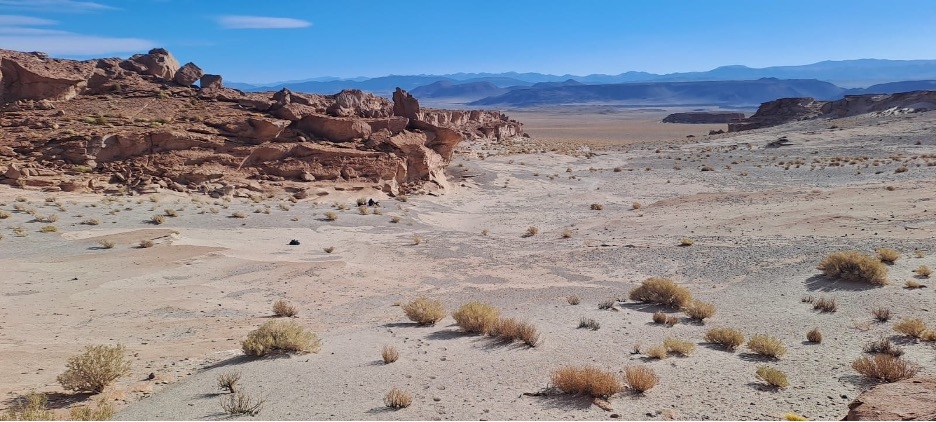
Through this skill building workshop participation and application of practical biogeochemical approaches, attendees will work to combine data acquired during regional pilot studies centred around the paleoenvironmental reconstruction and ecosystem dynamics of extinct megafauna that inhabited the Antofagasta de la Sierra region in Argentina during the late Pleistocene through the lens of coprolites and sediments analysis.
Objectives
PalCoproSA aims to enhance technical skills in:
1. the recovery of coprolites and sediments during archeological excavations;
2. the preservation of samples;
3. the application of multiproxy analysis (pollen, aDNA, phytoliths, botanical remains, stable isotopes, lipids, proteins, plant waxes, faecal biomarkers).
Project leaders:
Nadia Jimena Velázquez, Instituto de Investigaciones en Producción, Sanidad y Ambiente, Buenos Aires, Mar del Plata (Consejo Nacional de Investigaciones Científicas y Técnicas), Argentina
Michael Ziegler, Max Planck Institute of Geoanthropology, Department of Coevolution of Land Use and Urbanisation, Germany
Activities Scheduled
Date: 16-20th November, 2026
Place: Antofagasta de la Sierra, Catamarca, Argentina