

Podcast INQUA India 2027
Quaternary is the age when modern recognisable humans started inhabiting this planet.
All over the world scientists are engaged in studying various aspects of human evolution. Once every 4 years scientists from all across the Globe gather at one place and exchange their research, discoveries and views. In 2027 Lucknow (India) has the honour of hosting this congress.
Through this podcast, accompany Veraa on an amazing journey about human evolution, changing climate and reorganisation of environments.
To listen the podcast:
Season 6 – Episode 1 – Decoding the Quaternary through Geochemistry
One of the most powerful tools of geochemistry is stable isotope geochemistry.For example, the proportion of oxygen isotopes ¹⁸O and ¹⁶O acts as a paleo-temperature indicator. Lower proportions of 18O generally point to colder climates, while higher values suggest warmer conditions. Similarly, carbon isotopes help us understand vegetation patterns, with different proportions of 13C and 12C indicating whether landscapes were dominated by C₃ plants, C₄ plants or even CAM-type vegetation.
But that’s not all—trace elements can also tell a story.Ratios like the magnesium to calcium ratio in marine shells help estimate ancient sea surface temperatures. And in lakes or caves, proportions of elements such as strontium or barium reflect changes in rainfall and evaporation. Perhaps most strikingly, air bubbles trapped in ice cores preserve ancient atmospheres, giving us direct records of past concentrations of greenhouse gases like carbon dioxide and methane. Together, these geochemical proxies allow us to reconstruct climate with remarkable precision and understand how natural variability compares to today’s changes in the climate.
In simple terms, this means figuring out where sediments come from.
Every rock has a unique chemical fingerprint. By analyzing elemental and isotopic compositions, like strontium, neodymium, or lead isotopes, scientists can trace sediments back to their source regions. This is especially useful in understanding erosion patterns, river systems, and even ancient wind directions. For instance, wind-blown deposits like loess can be traced back to specific desert regions, revealing past aridity and atmospheric circulation. In glacial and river systems, geochemistry helps distinguish between locally sourced material and sediments transported over long distances.
At the Birbal Sahni Institute of Palaeosciences significant contributions have been made since its inception, especially in palynological studies from regions like Rajasthan, Uttarakhand, Himachal Pradesh, Jammu & Kashmir, and northeast India. Geochemical research gained strong momentum after the 1990s, particularly in river, coastal, and lake environments. A major turning point came in 2015 with the establishment of advanced geochemical laboratories at BSIP. These facilities include state-of-the-art instruments like XRD, ICP-OES/MS, IRMS, GC-MS, X-Ray Diffraction, Inductively Coupled Plasma-Optical Emission Spectroscopy / Mass Spectrometry, Isotope Ratio Mass Spectrometry, Gas Chromatography-Mass Spectrometry, and more, making it one of the most comprehensive setups in North India.
Latest developments
View moreLatest developments Royal Society meeting issue
Philosophical Transactions B under the ‘Subscribe to Open’ 2026 initiative
 Quaternary Science in Latin America: Building the Future from the Global South!
The First Latin American INQUA Meeting – 2026 is coming to Puerto Madryn, Patagonia, Argentina, on 11–12 November 2026! 🇦🇷
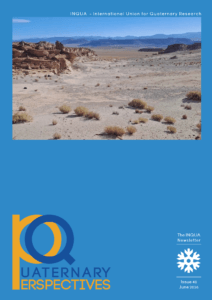 QP Issue 40 Now published
The new issue of Quaternary Perspectives was published!
 Geo-Research Scholars Meet 2026 India
The Geo-Research Scholars Meet, will be hosted by the Wadia Institute of Himalayan Geology, India
 International Winter School on Natural Hazard Attribution Using Past and Present Data
The winter school will take place at IIT Roorkee, India