INQUA 2615 sy: Quaternary far-travelled dust contributions to Mediterranean landscapes (Sirocco)
Abstract
Sirocco: Quaternary far-travelled dust contributions to Mediterranean landscapes
Each year, dust storms associated with large scale atmospheric systems transport, and deposit, substantial amounts of fine-grained sediment around the planet. It is reasonable to hypothesise that these dust-bearing air masses are not exclusive to the present day, but also transported dust throughout the Quaternary, regardless of the variations and regional reorganization of atmospheric dynamics over glacial-interglacial timescales. By this assumption, far-travelled dust would have become incorporated not only into classical loess-paleosol sequences, but also into other sedimentary deposits.
The Sirocco is noteworthy for its transport of dust from the Sahara across the Mediterranean each spring and summer, draping the balconies and cars of southern Europe. Quaternary loess deposits have been identified east of the Appenines, but are associated with Alpine glaciations rather than distal accumulation. So far no one has identified, or indeed specifically searched for, distal aeolian contributions to soils and sediments across southern Europe, including the western slopes of the Appenines which frequently bear the brunt of the Sirocco southerlies.
This IRN will address the question: is there Quaternary far-travelled dust in southern Europe?
We bring together a network of “Quaternary dust hunters”: researchers with expertise in Quaternary loess sedimentology and regional geology who are best equipped to identify, and characterize, distal dust within the soils of southern Europe. We will test the hypothesis that distal dust has been accumulating in Quaternary soils of the Mediterranean region. We will undertake a workshop, field reconnaissance and sampling by our team with expertise in aeolian sediments (including loess), regional geology and geomorphology.
We will focus on southern Italy, west of the Appenines, a region which is known to experience dust deposits associated with Sirocco winds. In this region, the local geology and soils contains no autochthonous quartz – one of the main components of far-travelled dust. We will sample soils from a wide geographical area from places with non-quartz-bearing geology, and analyse these samples, initially to identify quartz, then to isolate and characterize this material in terms of size, shape, and where applicable, trapped-charge and trace element characteristics. Eventually, we aim to establish the likely geographical sources, and age, of Quaternary-age quartz dust which has been incorporated into the Italian soils. The results of this project will provide a blueprint for identifying Quaternary far-travelled dust across the Mediterranean and beyond.
Project leader:
Dr. Kathryn Fitzsimmons – School of Earth, Atmosphere and Environment, Monash University, Australia
Latest developments
View moreLatest developments Podcast INQUA India 2027
Quaternary is the age when modern recognisable humans started inhabiting this planet. All over the world scientists are engaged in studying various aspects of human evolution. Once every 4 years scientists from all across the…
 INQUA Travel Grants for the XXII INQUA Congress 2027
Travel grants now open!
 8th Regional Meeting on Quaternary Geology, Slovenia – Call for abstracts
The event will take place from 4–6 November 2026 in Čatež ob Savi, East Slovenia.
 ONSEA Workshop 2026 – Online Event
The ONSEA workshops, originally planned in Morocco, will be switched ONLINE on 3-4 September 2026.
 Workshop on the impact of climate and environmental change on the peopling of southern South America (CLIMPEOP-SSA)
Lumen, Paris-Saclay University, France – 16-18 September 2026
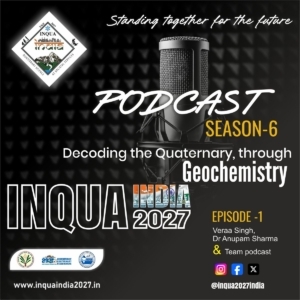 Podcast INQUA India 2027
Quaternary is the age when modern recognisable humans started inhabiting this planet. All over the world scientists are engaged in studying various aspects of human evolution. Once every 4 years scientists from all across the…