Podcast INQUA India 2027
Quaternary is the age when modern recognisable humans started inhabiting this planet.
All over the world scientists are engaged in studying various aspects of human evolution. Once every 4 years scientists from all across the Globe gather at one place and exchange their research, discoveries and views. In 2027 Lucknow (India) has the honour of hosting this congress.
Through this podcast, accompany Veraa on an amazing journey about human evolution, changing climate and reorganisation of environments.
To listen the podcast:
Season 6 – Episode 3 – Luminescence as a Time Step
There are many methods to get timestamps for past events, such as looking for fossils of a specific time period, or radiocarbon dating. Today, we’ll learn about another method popularly used by Quaternary scientists, called luminescence dating. By the way, where can we find these timestamps? Almost everywhere – lake deposits, glacial deposits, flood deposits, tsunami deposits, marine deposits – wherever there is quartz sediment, we can find luminescence timestamps. For example, this luminescence timestamp is present in the potteries, bricks and urns in archaeological sites. And thus, this method is helpful in archaeological studies and getting insights about past human societies and civilizations.
The Luminescence Dating Laboratory at BSIP, Lucknow was established in 2015. Since then, Dr. Morthekai’s group has contributed to several important works and discoveries. For example, they dated the oldest glacial expansion which occurred 80 thousand years ago, of the Kalla Glacier in the Central Himalayas. They identified and quantified the presence of rock derived organic carbon in Central Himalayan lake sediments. They also established luminescence dating methods to use on diatoms – a type of unicellular organisms which produce siliceous shells or fossils. They developed techniques to record a new signal, which is called re-distributed infra-red stimulated luminescence or RD-IRSL, and this can be used to date material older than 780 thousand years.
Dr. P Morthekai Veraa Singh & Team Podcast
Latest developments
View moreLatest developments Royal Society meeting issue
Philosophical Transactions B under the ‘Subscribe to Open’ 2026 initiative
 Quaternary Science in Latin America: Building the Future from the Global South!
The First Latin American INQUA Meeting – 2026 is coming to Puerto Madryn, Patagonia, Argentina, on 11–12 November 2026! 🇦🇷
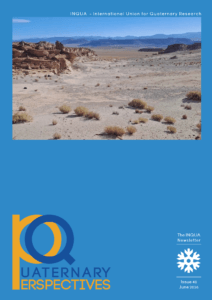 QP Issue 40 Now published
The new issue of Quaternary Perspectives was published!
 Geo-Research Scholars Meet 2026 India
The Geo-Research Scholars Meet, will be hosted by the Wadia Institute of Himalayan Geology, India
 International Winter School on Natural Hazard Attribution Using Past and Present Data
The winter school will take place at IIT Roorkee, India